Apartment Intercom Not Working? What’s Likely Wrong and Who Pays

If your apartment intercom isn’t working, first work out whether the fault is in one apartment or the whole building. Then report it. If you rent, tell your property manager first, whichever part failed. If you own and the fault is shared, tell the body corporate manager or committee. In a Queensland scheme, shared parts usually fall to the body corporate, and parts inside your lot that serve only your lot usually fall to you. Who can do the repair depends on the part.

How to check an intercom: compare your apartment with a neighbour’s
A simple way to check an intercom is to compare your apartment with one other apartment, because that shows whether the problem is yours alone or shared.
- Ask a neighbour whether their handset rings and whether they can talk to the entrance panel.
- Stand at the entrance panel and call your own apartment while someone listens inside.
- Have someone press the door release while you watch the door. Note whether the lock releases.
- Look at the panel. If it normally has lights or a screen, note whether they’re on.
- Write down the date, the time and what happened at each step.
If only your apartment fails, the fault is more likely in your handset or the cabling to it. If neighbours have the same problem, look at shared equipment such as the entrance panel, the power supply or the door lock.
Those checks are as far as a resident should go. Don’t open the handset or the panel. Aiphone’s manual for its GT-1D residential station warns that dismantling or altering the unit could cause fire or electric shock, and it sends malfunctions to a qualified technician. That’s one product’s manual, but it’s a sensible line for other intercoms too.
What each intercom symptom points to: a starting clue for the technician
A symptom narrows the search but doesn’t prove the cause. This table is general reasoning, so expect a technician to test first. If you rent, your first call in every row is your property manager.
| What you notice | What it could point to | Who to tell first (renters: your property manager) |
|---|---|---|
| One handset has no sound and neighbours are fine | That handset or the cabling to it | The lot owner. If that’s you, also tell the body corporate manager or committee |
| One apartment can talk but can’t release the door, and neighbours can | That handset’s release button or its connection | The lot owner. If that’s you, also tell the body corporate manager or committee |
| Nobody can be called and the panel looks dead | The power supply or the entrance panel | The body corporate manager or committee |
| Everyone can talk but nobody can release the door | The door lock, its power or the link between the panel and the lock | The body corporate manager or committee |
| The entry door won’t lock or stays open | The lock, the door hardware or a release that’s stuck | The body corporate manager or committee, straight away |
| Buzzing or crackling on several handsets | Shared cabling or power | The body corporate manager or committee |
| Calls to a phone or app have stopped but handsets still work | The internet connection, the app account or a mobile SIM | Whoever manages that service for the building |

Two details from the GT-1D manual show why a quick test can mislead. Depending on the door release system, the release may only work while the button is held down, so try holding it before you report a fault. That same unit gets its DC 24 V power from another part of the system, the GT-BC, so on a system built that way a dead handset doesn’t have to be a handset fault.
Who pays in a Queensland scheme: usually the body corporate for shared parts
In a Queensland community titles scheme, the body corporate usually pays to maintain shared intercom parts, and the lot owner usually pays for parts inside the lot that serve only that lot. A body corporate must maintain the common property, and an owner must maintain their lot.
The Queensland Government maintenance pages we checked don’t mention intercoms, so this is our reading of the general wording. Those pages describe utility infrastructure as the cables, wires, plant and equipment that supply a utility service, and that service can be another system designed to benefit a lot or common property. The Standard Module regulation lists intercoms among the communication services a body corporate may supply.
Start by finding your scheme’s survey plan and regulation module, because boundaries are defined differently depending on the plan. Titles Queensland can give you the plan and the community management statement, which shows the module. If your scheme sits under another Act, such as the Building Units and Group Titles Act 1980, the wording differs, so check first.
| Part of the intercom | Who usually maintains it, if the utility rules apply | Why |
|---|---|---|
| Entrance panel on common property | Body corporate | It’s on common property |
| Cabling that serves more than one apartment | Body corporate | It services more than 1 lot |
| Cabling inside a wall between your lot and a corridor or neighbour, serving only your lot | Not settled for intercoms: body corporate, unless the exception below applies | It’s in a boundary structure, but it relates only to your lot |
| Handset and cabling inside your lot, serving only your lot | Lot owner | It’s within the lot and only services that lot |
| Something an occupier added for their own benefit | Lot owner | The occupier installed it for their benefit |
| Equipment installed under a supplier’s agreement | Check the agreement | It may remain the provider’s property |
The handset inside your apartment: usually your cost if it passes three tests
A handset inside your apartment is usually the lot owner’s cost if it passes the single-lot test in section 20 of the Body Corporate and Community Management Act 1997. Utility infrastructure stays common property unless it meets all three parts of the test below.

| Part of the test | Question to ask | What would fail it |
|---|---|---|
| Supplies only 1 lot | Does it serve your lot alone? | A cable shared with a neighbour |
| Within the lot’s boundaries | Is it inside your lot on the survey plan? | A panel in the foyer |
| Not in a boundary structure | Is it clear of the floors, walls and ceilings on your boundary? | A cable inside the wall you share with a corridor |
A boundary structure is a floor, a wall or a ceiling (other than a false ceiling) containing the boundary between your lot and another lot or common property. So the handset might be yours and its cable might not.
That test settles what’s common property, but section 180(4) of the Standard Module adds an exception on who maintains it. Despite the body corporate’s duty, an owner is responsible for utility infrastructure, including on common property, that relates only to their lot and is a listed type. The list ends with “another device providing a utility service to a lot”, and one of its examples, a hot-water system, takes in the associated pipes and wiring. The sources we checked don’t say whether an intercom handset and its cable qualify, so under the Standard Module it’s unsettled.
A body corporate can’t pay for, or levy owners for, maintenance a lot owner is responsible for, unless it has an agreement with that owner and charges them for the work.
If it’s disputed, call the body corporate information service on 1800 060 119 (freecall) for a general view. It can’t give legal advice or rulings. This page is general information too, so if a dispute over cost is building, get legal advice.
If you rent: tell your property manager in writing
If you rent, tell your property manager or owner in writing as soon as you can, and they’ll deal with the body corporate if that’s needed. Don’t organise a routine repair without written permission, and keep paying rent while you wait. The RTA says non-payment is a breach of the agreement.
| Your situation | What to do |
|---|---|
| You believe it’s on the emergency list | Try to reach the emergency contact on your tenancy agreement as soon as you know about it |
| Common property isn’t being maintained | Ask the body corporate in writing. Your landlord can give you the body corporate manager’s or committee secretary’s details |
The RTA’s emergency repairs list doesn’t name intercoms, so don’t assume yours counts. Read it against your situation, especially a fault that makes the premises unsafe or insecure, and a serious fault in a staircase, lift or other common area that unduly inconveniences you in getting in. If you’re not sure, ask the RTA on 1300 366 311.
Who can fix an intercom: a security installer, an electrician or both
An intercom repair can need a security installer, an electrician or both, because Queensland licenses the two kinds of work under separate Acts.
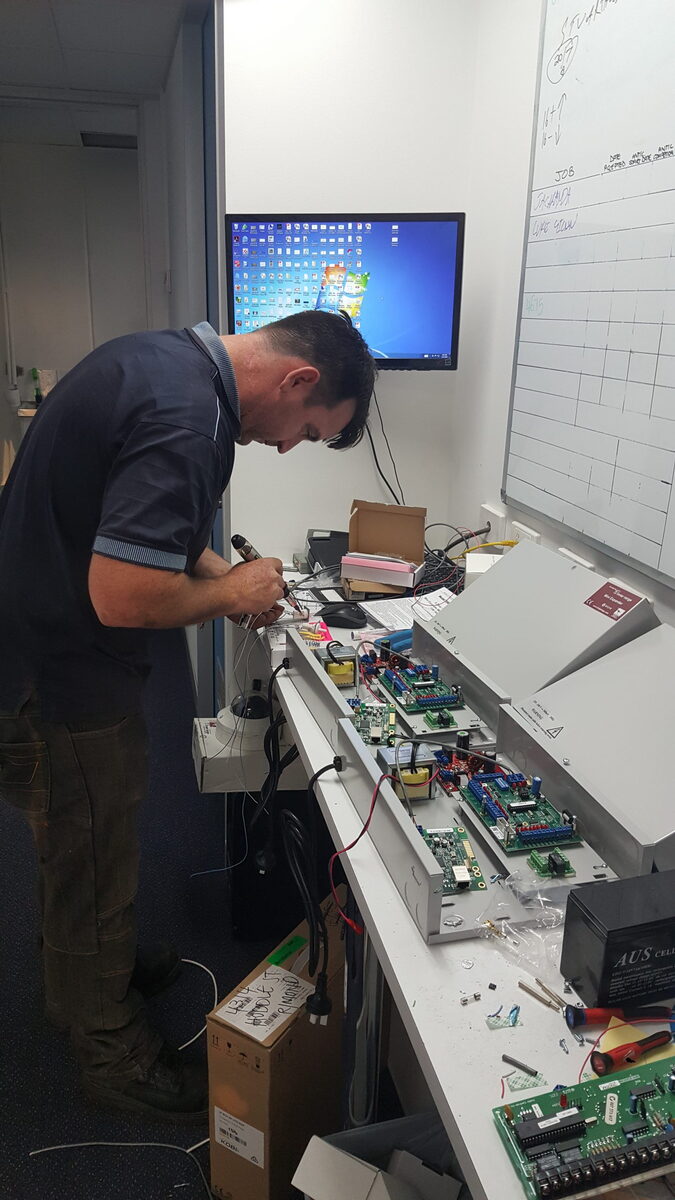
Under the Security Providers Act 1993, a person who installs, repairs, services or maintains security equipment for reward is a security equipment installer and needs the appropriate licence. There are exceptions, such as an employee working on their employer’s own equipment. Security equipment includes equipment designed or adapted to provide or enhance property security, and the Act’s examples include an electric access control device. It doesn’t name intercoms. As we read it, a door release is the clearer case, because it’s the part acting as access control. A talk-only handset is less clear, so ask if you’re unsure.
Under the Electrical Safety Act 2002, repairing or replacing electrical equipment is electrical work, and it needs an electrical work licence that covers it, with listed exceptions. Electrical equipment generally means equipment running above extra low voltage, which is 50V AC or less, or 120V ripple-free DC or less. The Electrical Safety Regulation 2026, in force since 1 September 2026, says an electrical mechanic licence authorises all electrical work.
| Part of the job | Licence to ask about |
|---|---|
| Mains power feeding the intercom’s power supply | Electrical work licence |
| Electric door release or lock | Security equipment installer licence for a lock, which the licence page lists. As we read it, a door release counts too, because the Act’s examples include electric access control devices |
| Handset or panel running at extra low voltage | Ask the repairer which licence they rely on, and check with the Office of Fair Trading if you’re unsure |
Anything wired to mains power is a job for a licensed electrician, and residents should leave it alone. Queensland also keeps a free public register of security licences, for information only, so you can look up a firm before you book it.
What to report: give the committee enough to act on
Give the body corporate manager or committee, or your property manager if you rent, enough detail to brief a technician the first time:
- the building address and your lot number
- which apartments you’ve confirmed are affected
- whether the entry door still locks and still releases
- what you tried, with the date and time
- a photo of the entrance panel, and the brand name if you can see it without opening anything

Can the committee approve it without a general meeting? Yes, if it’s inside the limit
A committee can approve an intercom repair without a general meeting if the cost is inside its spending limit and the money is in the budget. Under the Standard, Accommodation and Small Schemes Modules, owners can set that limit by ordinary resolution. If they haven’t, it’s worked out from the number of lots, and the Queensland Government’s committee spending page has the formula. GST counts, and a committee can’t split one project into smaller parts to fit under the limit.
| Situation | What’s needed |
|---|---|
| Cost is above the major spending limit | At least 2 quotes. One may be enough in exceptional circumstances, such as a part that only one source can supply |
| Cost is above the committee’s limit | An ordinary resolution of the body corporate, or written consent from all owners |
| Spending above the limit to meet an emergency | An adjudicator can authorise it by order |
| Spending needed to comply with a statutory order or notice, an adjudicator’s order or a court’s judgment or order | The committee can go over its limit for this |
| Commercial Module scheme | No spending limit, but spending must be authorised at a committee meeting or by a vote outside one |

When repair stops making sense: weigh parts and repeat faults
Repair tends to make sense while the fault is isolated and parts can be found, and replacement is worth pricing when that stops being true. Neither one wins for every building.
| What to look at | Leans towards repair | Leans towards replacement |
|---|---|---|
| Parts | The failed part can still be found | The part can’t be found or the maker no longer supports it |
| Fault history | One part failed, once | Faults keep returning in different parts |
| What the building wants | The system still does the job | Owners want something it can’t do, such as video |
| Mobile connection | It doesn’t use a mobile SIM, or its SIM runs on 4G or 5G | It relied on 3G and hasn’t been updated |
The approval can change too. Adjudicators’ orders have used a like for like rule to separate maintenance from improvements. Replacing something with a similar item is maintenance, while a change can be an improvement. If you can’t get the same product, the change isn’t automatically an improvement. Swapping audio for video could count as one, and under the Standard, Accommodation and Small Schemes Modules the approval for an improvement depends on its cost.
On the 3G point, TPG Telecom switched off its network in January 2024, and Telstra and Optus followed in November 2024. The federal Department of Infrastructure says some security systems and lift phones lost function. It doesn’t name intercoms, so if yours calls phones through a SIM, ask your provider or the maker.
Getting help in Brisbane
Access Alarms is based at Eagle Farm and opened in December 2006. We work with audio and video intercoms for commercial buildings and apartments, and our servicing covers fault repair and maintenance, including systems other companies installed. We work across Brisbane and South East Queensland, and you can call us on 1300 049 969. See our pages on commercial intercoms, body corporate security, intercom systems in Newstead and body corporate security in Newstead.

Next steps
If the fault looks bigger than one part, read what drives intercom replacement cost. If you’re ready to talk about a repair, see our intercom systems service.
Frequently asked questions
Who pays to fix an apartment intercom in Queensland?
It depends on which part failed and where it sits. Equipment and wiring on common property, in a boundary structure or serving more than one lot usually fall to the body corporate. Equipment inside a lot that serves only that lot usually falls to the owner. A Standard Module exception can move some single-lot devices to the owner, and it’s unsettled for intercoms. The Queensland maintenance pages we checked don’t mention intercoms, so check your survey plan and get legal advice if there’s a dispute.
Can an electrician fix an intercom?
An electrician with an electrical mechanic licence can do electrical work, including the mains power feeding an intercom. Repairing an electric door release for reward is a separate question. As we read it, Queensland’s Security Providers Act covers that work, and it requires the appropriate licence, with limited exceptions. Ask which licences they hold, and look up security licences on the state’s free register.
What should I tell the strata manager?
Tell them your lot number, whether other apartments have the same problem and whether the entry door still locks and releases. Add when it started and a photo of the entrance panel. You can reach the body corporate through its manager or committee secretary. If you rent, send it to your property manager instead.
I rent my apartment. What do I do?
Write to your property manager or owner as soon as you notice the fault and let them deal with the body corporate. Don’t stop your rent, and don’t book a routine repair without written permission. If the fault leaves your home unsafe or insecure, read the RTA’s emergency repairs list and try the emergency contact in your tenancy agreement.
Why does only my unit have no sound?
When neighbours can talk to the entrance panel and you can’t, the shared equipment is probably working, which points to your handset or the cabling to it. A technician’s test is what confirms it. If the cabling runs through a boundary wall, it may not be yours to pay for even if the handset is, so report it before you book anyone. Owners can report it to the body corporate manager or committee, and renters to their property manager.

Is a door that won’t lock urgent?
Treat it as urgent, because it could let strangers into the building. Owners should tell the body corporate manager or committee straight away. Renters should tell their property manager first and check the RTA’s emergency repairs list, which covers faults that make premises unsafe or insecure. Where spending above the committee’s limit is needed to meet an emergency, an adjudicator can authorise it.
When is it time to replace instead of repair?
Start looking at replacement when parts can’t be found or faults keep coming back in different places. For a body corporate, adjudicators have treated a similar replacement as maintenance, while a real change can count as an improvement and need a different approval. Ask your body corporate manager which applies before the committee accepts a quote.
Does this apply to an office or warehouse building?
The licence rules do, with one difference. The security licence depends on the work being done for reward, while the electrical licence rule applies either way, with its own listed exceptions. Queensland’s security licence page lists locks for commercial or residential areas. The body corporate rules here apply to a building in a community titles scheme. A body corporate under another Act has different wording, so check first. A scheme under the Commercial Module has a committee with no spending limit, although spending must still be authorised by the committee.
Sources
- Body corporate maintenance. Queensland Government. qld.gov.au. Accessed 5 November 2026.
- Utility infrastructure maintenance. Queensland Government. qld.gov.au. Accessed 5 November 2026.
- Building format plan and building units plan maintenance. Queensland Government. qld.gov.au. Accessed 5 November 2026.
- Standard format plan and group titles plan maintenance. Queensland Government. qld.gov.au. Accessed 5 November 2026.
- Improving common property and lots. Queensland Government. qld.gov.au. Accessed 5 November 2026.
- Committee spending. Queensland Government. qld.gov.au. Accessed 5 November 2026.
- Body corporate spending. Queensland Government. qld.gov.au. Accessed 5 November 2026.
- Renting in a body corporate. Queensland Government. qld.gov.au. Accessed 5 November 2026.
- Apply for a security equipment installer licence. Queensland Government. qld.gov.au. Accessed 5 November 2026.
- Check a security licence. Queensland Government. qld.gov.au. Accessed 5 November 2026.
- Body Corporate and Community Management Act 1997 (Qld), section 20. Queensland Legislation. legislation.qld.gov.au. Accessed 5 November 2026.
- Body Corporate and Community Management (Standard Module) Regulation 2020 (Qld), including section 180. Queensland Legislation. legislation.qld.gov.au. Accessed 5 November 2026.
- Security Providers Act 1993 (Qld), sections 6B, 8A and 9. Queensland Legislation. legislation.qld.gov.au. Accessed 5 November 2026.
- Electrical Safety Act 2002 (Qld), sections 14, 18 and 55 and the definition of extra low voltage. Queensland Legislation. legislation.qld.gov.au. Accessed 5 November 2026.
- Electrical Safety Regulation 2026 (Qld). Queensland Legislation. legislation.qld.gov.au. Accessed 5 November 2026.
- Routine repairs. Residential Tenancies Authority. rta.qld.gov.au. Accessed 5 November 2026.
- Emergency repairs. Residential Tenancies Authority. rta.qld.gov.au. Accessed 5 November 2026.
- Body corporate rental properties. Residential Tenancies Authority. rta.qld.gov.au. Accessed 5 November 2026.
- 3G network switch off. Department of Infrastructure, Transport, Regional Development, Communications, Sport and the Arts. infrastructure.gov.au. Accessed 5 November 2026.
- GT-1D Apartment Intercom System residential station operation manual. Aiphone. aiphone.com. Accessed 5 November 2026.